


The railway sector is the backbone of modern transportation, moving billions of tons of cargo and countless passengers across vast networks. With increasing train speeds and higher traffic densities, the demand for unparalleled safety measures has become non-negotiable. Traditional safety methods are often insufficient to address the complexities of modern rail operations, making the integration of purpose-built physical barriers essential. This is where Advanced Railway Crash Barrier Solutions step in, offering a critical defense line that safeguards lives, protects massive infrastructure investments, and ensures the continuous reliability of national rail networks. These solutions represent the pinnacle of engineering dedicated to mitigating the devastating consequences of derailments, collisions, and external intrusions. Their implementation is not just an expense, but a fundamental investment in the future resilience and security of global transportation systems.
The Critical Need for Advanced Railway Crash Barrier Solutions
The operational environment of a railway is profoundly different from that of a roadway, necessitating specialized safety equipment. While vehicular accidents are typically mitigated by W-beam barriers and guardrails, the forces involved in a train incident are magnitudes higher, involving immense kinetic energy derived from tremendous speeds and heavy rolling stock. A conventional crash barrier designed for highway use would fail instantly under the impact of a loaded train.
Modern railway infrastructure requires protection systems that are engineered to:
- Containment: Prevent trains from leaving the track corridor during a derailment, especially in high-risk areas like elevated sections, steep embankments, or near adjacent public areas.
- Redirection: Manage and redirect impact forces to slow the rolling stock and minimize collateral damage to critical assets, such as overhead electrification masts or signal equipment.
- Security: Act as a robust physical deterrent against unauthorized access, vehicle intrusions at level crossings, and potential deliberate acts of sabotage.
The complexities of rail alignment—including sharp curves, tunnels, and bridges—demand a highly adaptable and structurally superior barrier system. This specialized requirement makes the adoption of Advanced Railway Crash Barrier Solutions not merely beneficial, but absolutely mandatory for meeting contemporary safety standards.
Distinguishing Rail Safety Challenges
Unlike vehicular impacts, a railway incident often involves continuous impact over a significant distance as the rest of the train follows the initial point of derailment. Furthermore, the operational challenges include:
- Higher Impact Forces: Barriers must withstand forces generated by multi-ton locomotives and carriages traveling at high velocity.
- Vibration and Movement: Systems must remain structurally sound despite constant, intense vibration from passing trains and natural track movement.
- Clearance Requirements: Barriers must be designed to strict dimensions to avoid interfering with the loading gauge and overhead wire systems, demanding precision engineering and slim profiles.
Engineering Excellence: Key Features of Modern Advanced Railway Crash Barrier Solutions
The effectiveness of modern rail safety systems lies in their integration of advanced metallurgy, smart engineering principles, and a commitment to rigorous testing. Advanced Railway Crash Barrier Solutions are defined by specific characteristics that distinguish them from standard protective infrastructure.
High-Strength Materials and Structural Integrity
The foundation of a reliable railway barrier is the material it is constructed from. Leading solutions utilize high-strength construction-grade materials, primarily:
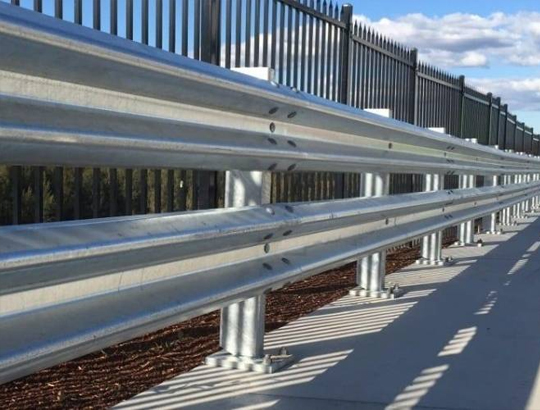
- High-Strength Galvanized Steel: Used in components like W- and Thrie-beam sections, the galvanization process provides superior corrosion resistance, ensuring longevity in varied climatic conditions. This high tensile steel provides the necessary flexibility to absorb initial impact while maintaining the shear strength required for containment.
- Reinforced Concrete: Often used for foundational elements or in specialized applications like anti-climb walls, providing immense mass and immovable structural reinforcement.
Every component, from the posts to the terminal ends, undergoes exhaustive engineering analysis to guarantee performance under maximum design load, ensuring structural integrity is maintained even in the harshest operational environments.
Modular Design for Customization and Maintenance
Flexibility is a key attribute of Advanced Railway Crash Barrier Solutions. Modern systems are engineered with a modular approach, offering significant advantages:
- Easy Installation: Pre-fabricated sections simplify the installation process, reducing track-side work time and minimizing operational disruption.
- Scalability: Systems can be readily customized in terms of length, height, and configuration to perfectly match the specific geometry of the railway alignment, whether it’s a straight high-speed corridor or a tight curve.
- Straightforward Maintenance: In the event of an impact, the modular nature allows for quick replacement of damaged sections, drastically lowering repair costs and turnaround time compared to monolithic structures.
Impact Absorption and Energy Dissipation
The primary function of an Advanced Railway Crash Barrier Solution is not simply to stop a train, but to manage and dissipate the immense kinetic energy involved in a collision. Sophisticated designs incorporate features that achieve this through controlled deformation. By yielding in a predictable manner, the barriers absorb the energy of the impact over a greater distance, significantly reducing the deceleration forces exerted on the rolling stock and minimizing the potential for further structural damage or injury. This controlled energy management is paramount to the system’s success.
Visibility and Compliance
Ensuring compliance with the highest national and international railway safety guidelines is non-negotiable. Beyond structural performance, modern solutions include:
- Visibility Enhancements: High-grade reflective coatings and mandatory safety signage are integrated into the barrier design. This crucial feature improves visibility for train operators and track workers, especially during night-time operations or in low-light environments, further enhancing overall safety along the entire railway corridor.
- Regulatory Adherence: Reputable manufacturers adhere strictly to official railway safety codes, ensuring that all deployed Advanced Railway Crash Barrier Solutions meet the mandated clearance, height, and strength specifications for reliable, optimal performance in real-world operational scenarios.
Real-World Applications of Advanced Railway Crash Barrier Solutions
The versatile design of high-quality Advanced Railway Crash Barrier Solutions makes them applicable across the entire spectrum of railway infrastructure, providing targeted protection where risks are highest.
Securing High-Speed Corridors
On high-speed railway lines, the risk of catastrophic incidents like high-velocity derailment is elevated. In these critical areas, barriers provide an indispensable safety layer, acting as a final retention wall that guides runaway rolling stock parallel to the track, thereby protecting adjacent lines, vital infrastructure, and nearby communities. They are essential for protecting the significant public investment in this critical VNM Infratech OPC PVT LTD asset.
Protecting Level Crossings and Urban Networks
Level crossings are statistically among the most vulnerable points in a railway network. Barriers installed at these locations significantly improve security by actively blocking unauthorized vehicle or pedestrian intrusion onto the railway tracks, thereby minimizing the potential for accidents and fatalities. Similarly, in densely populated urban rail networks, these solutions offer a crucial defense against inadvertent access, effectively securing the safety of both operating trains and the public.
Reinforcement for Bridges and Curved Sections
Sections of the track involving bridges, viaducts, or tight curves present unique hazards. On bridges, barriers prevent catastrophic falls. In curved sections, they mitigate the effects of centrifugal forces during a derailment, providing structural reinforcement and ensuring that kinetic energy is contained within the immediate rail right-of-way. Customized barriers are often required here to ensure maximum effectiveness without compromising the structural integrity of the existing bridge architecture.
The Long-Term Value of Investing in Advanced Railway Crash Barrier Solutions
While the initial procurement of high-grade Advanced Railway Crash Barrier Solutions represents a substantial capital outlay, the long-term economic and human value far outweighs the cost. Investing in these systems is, in essence, a cost-effective strategy for comprehensive risk mitigation.
By successfully preventing even a single major accident—which can lead to loss of life, expensive track closure, complete rolling stock replacement, and extensive litigation—the barriers deliver substantial returns. Designed for exceptional longevity and requiring minimal scheduled maintenance beyond post-impact repair, they promise long-term value. This is a strategic investment that railway operators make to achieve enhanced network uptime, predictable operational reliability, and, most importantly, peace of mind regarding safety compliance and passenger welfare.
Conclusion
The future of railway transportation is defined by speed, efficiency, and, above all, safety. The integration of Advanced Railway Crash Barrier Solutions is a crucial leap forward in achieving this goal. By leveraging high-strength materials, pioneering modular design, and superior impact absorption capabilities, these barriers provide the robust, reliable protection that modern railway environments demand. For any infrastructure project committed to the highest standards of safety and resilience, choosing solutions engineered for rail-specific challenges is the only viable path forward. The continued deployment of these advanced systems is key to safeguarding the lives of passengers and employees, protecting critical assets, and ensuring the smooth, safe operation of the world’s vital rail networks for generations to come.